The Tax Agency has its new system ready to monitor the electronic invoices of freelancers and companies in real time. With this tool, the Tax Agency will be able to instantly know businesses' operations and their taxes.

Verifactu is a verifiable invoicing system created to give the Tax Agency greater transparency, traceability and real-time control, preventing double bookkeeping. It's one of the measures included in the Anti-Fraud Law whose regulation was approved in October 2024 (Order HAC/1177/2024). It sets out the requirements that future invoicing programs must meet, including the ability to use this verifiable invoicing system.

Verifiable invoice issuing systems allow freelancers' invoicing programs to exchange tax and accounting information in real time with the Tax Agency.
See more
Invoices issued through these programs will include the phrase «VERI*FACTU», which means all the information has been sent to the Tax Agency automatically and under the Administration's supervision.

These systems were first discussed during the drafting of the regulation, which set out the requirements that invoicing software programs would have to meet.
See more
These requirements also help prevent the well-known dual-use invoicing programs, used to hide off-the-books accounting from the Tax Agency.

The verifiable invoicing system will allow freelancers and businesses to instantly send all their invoices to the tax authorities. This will make it possible for tax returns and filings to be practically pre-filled.
See more
It will also give businesses greater transparency toward the Administration and their clients, among other advantages detailed below.
The timeline starts in July 2025 for software manufacturers, continues in January 2027 for companies, and ends in July 2027 for freelancers.

Our invoicing software complies with the VeriFactu regulation and updates automatically, so you don't have to worry about technical changes.

With Quipu you can adapt to VeriFactu easily, avoiding penalties, saving time, and managing your invoices securely.

VERIFACTU enables your invoicing software to send automatically and in real time the records of each invoice to the AEAT, providing traceability and transparency. This makes it easier to auto-fill ledgers and self-assessments, it reduces errors and requests, and it certifies compliance with the Anti-Fraud Law against the use of dual-use software. Although its use by businesses and freelancers is optional, all programs must offer this capability in accordance with the regulation and Order HAC/1177/2024.

Instant sending of invoicing records to the AEAT.
Traceability through the “VERIFACTU” mark, QR code, and verification in the electronic office.
Time savings: pre-filled bases for tax returns and ledgers.
Fraud prevention and alignment with current regulations.
Until now, the Tax Agency had only made public two documents referring to VERIFACTU. These invoice verification systems were first regulated in the text submitted for public consultation to develop the future requirements that invoicing software will need to meet.
Some time later, the IT Department of the Tax Agency issued a draft of the technical requirements that these verifiable invoicing systems would need to meet.

Now, and following the approval of the regulation for invoicing software, these would be the main features of verifiable invoicing programs:
It's an optional measure that any self-employed professional or business owner can adopt.
The systems will send invoicing records to the Tax Agency so it can view them in real time.
Every time an invoice is recorded in the system, the software will send it automatically to the Tax Agency.
When the regulation comes into force, all invoicing software must be able to submit verifiable invoices, provided the business owner opts in.
Verifiable invoices will be sent via XML messages to the Tax Agency.
These invoices will include the label «VERI*FACTU» when issued to customers
Verifiable invoice records won't need to include an electronic signature at the time of registration or cancellation.
In the future, business owners who adopt this system will have some or all of their tax self-assessments and returns already completed by the Tax Agency.
VERI*FACTU isn't a future project: it's a current, regulated option. Among its advantages we find: transparency, efficiency, simplicity, and security.

It will allow businesses to project an image of transparency to their business and individual customers -showing that they record and send all transactions to the Tax Agency- and also to the Administration, when it comes to accessing public tenders or bids
Self-employed professionals and businesses, especially the smallest ones, could end up having all their tax returns completed thanks to the data they've sent to the Tax Agency. This means significant cost and time savings in preparing tax forms as well as accounting ledgers.

Having sent all their transaction data to the Tax Agency, business owners will also avoid oversights from leaving out some income. This reduces the risk of penalties for not reporting invoicing correctly.

Another advantage closely related to the previous one would be reducing potential requests for information. With access to all invoices, the Tax Agency will likely need less data from the business and, therefore, carry out fewer checks on activities that use VERIFACTU.

If you want to know more about how VERIFACTU and the SII will coexist, we recommend reading our dedicated article.
Real-time submission isn't mandatory: VERI*FACTU is an option. What you do need is a SIF that meets the requirements (QR, traceability, integrity); from there, you choose whether or not to submit to the AEAT.

Another matter is the invoicing software developers. In this case, they will indeed be required to include, at a minimum, the option for users to use the Verifactu system if they wish.
On the other hand, and even though the system is voluntary for users, we shouldn't forget that Verifactu is also a tool for the Tax Agency to monitor taxpayers and identify which companies are reliable and send all your invoices transparently, and which ones don't.
That's why at Quipu we recommend that if you do things right and keep all your taxes up to date, you submit your invoices to save yourself trouble and, along the way, give more reliability to your clients and suppliers, who will clearly see the seal of “invoice verified by the Tax Agency”.
The Anti-Fraud Law has been approved since 2021, and most of its measures—for example, the fines of up to 50,000 euros for businesses using double-accounting software—came into force shortly afterward.
However, the obligation for companies to change their invoicing software and comply with the new requirements—including the incorporation of Verifactu in their programs— was pending the approval of the regulation on invoicing software.
The entry into force of VERIFACTU depended on the approval of the regulation setting out the requirements for invoicing software.
Published in the BOE is the Order HAC/1177/2024, which sets out the requirements that invoicing software must meet.
From this date, the countdown begins for the progressive rollout of VeriFactu.
The AEAT consolidates the technical details for certified software: real-time submission, continuity of records, and information security and integrity.
From this moment on, manufacturers and distributors can only sell invoicing software that is certified in accordance with the Anti-Fraud Law.
All companies must issue and send verifiable invoices in real time through VeriFactu. This activates the first direct obligation for taxpayers.
Self-employed individuals will have to use exclusively adapted invoicing software. This milestone completes the full rollout of the VeriFactu system.
Select your business type and find out in seconds how VeriFactu affects you: how many days you have left to adapt and how urgent it is for you. That way you'll avoid penalties and can plan the transition with time to spare.
Freelancers will have to use invoicing software certified by the AEAT from that date. Although the system is voluntary at first, we recommend activating it as soon as possible to gain transparency and simplify tax management. From that day on, you'll need to use certified software to send invoices to the AEAT in real time.
⏰ You have [X days] left → Priority: Low (plan calmly).
Companies are the first required to adopt VeriFactu. From this date, they must issue verifiable invoices in real time, ensuring traceability and integrity of records. Companies are the first required to adopt VeriFactu. They must adapt their invoicing system and guarantee traceability and immediate submission to the Tax Authorities. From that day on, you'll need to use certified software to send invoices to the AEAT in real time.
⏰ You have [X days] left → Priority: Low (plan calmly).
Advisory firms manage portfolios with dozens of clients and, for this reason, must get ahead of the official deadline. Although the legal obligation for companies begins in January 2026, in practice it will be necessary to have certified software before October 2025 in order to migrate invoices, train teams, and adapt processes with sufficient lead time. Delaying can cause bottlenecks in January and increase the risk of penalties for your clients.
⏰ You have [X days] left → Priority: Low (plan calmly).
If you currently use non-certified invoicing software, you'll need to migrate to an adapted one before the deadline. Using non-certified software can lead to penalties and the inability to issue valid invoices. If you currently use non-certified invoicing software, you'll need to migrate to software that meets VeriFactu's technical requirements before that date. From that day on, you'll need to use certified software to send invoices to the AEAT in real time.
⏰ You have [X days] left → Priority: Low (plan calmly).
This includes cooperatives, associations, and other corporate structures. All of them will need to align with the AEAT system and use certified software to send invoices in real time. This includes professionals or businesses with special situations (cooperatives, associations, or other corporate structures). All of them will need to be aligned with the AEAT system. From that day on, you'll need to use certified software to send invoices to the AEAT in real time.
⏰ You have [X days] left → Priority: Low (plan calmly).
Beyond the key dates, every type of business has specific obligations. Here you can see how VeriFactu affects you and what happens if you don't adapt in time.

Mandatory from 1 July 2027. You'll need to use certified software and send invoices in real time. Delaying could mean penalties and loss of deductions.

Mandatory from 1 January 2027. Businesses must adapt their software right away. Failing to do so can lead to financial penalties and administrative blocks.

From July 2025, invoices issued with software not certified by the AEAT will no longer be accepted. Invoicing with outdated software can invalidate your tax documents.

Penalties for failing to comply with VeriFactu can range from financial fines to the inability to deduct expenses. Adapting in time avoids legal and financial risks.
A simple three-step process: invoice, automatic submission and AEAT confirmation. Total transparency with no hassle.



Save time, reduce risks and gain confidence with invoices verified in real time by the AEAT.
With VeriFactu you can cut invoice management time from more than 4 hours to just 30 minutes.
This monthly saving means more efficiency and less administrative burden for your business.
Current time: 4h → With VeriFactu: 30 min
Automatic, real-time submission builds trust with the Tax Authority and reduces the likelihood of inspections.
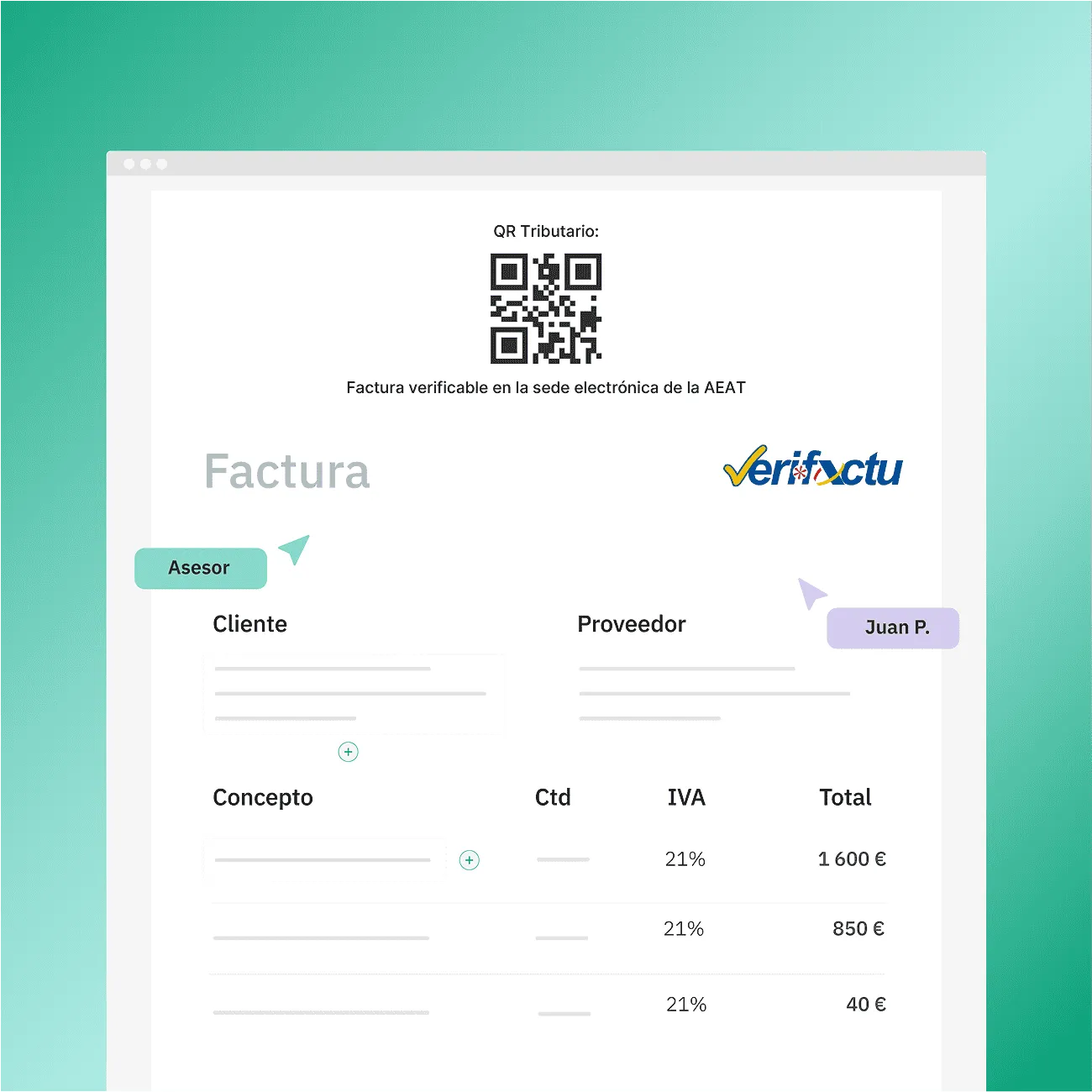
Every invoice issued includes the "VeriFactu" seal, a verifiable QR code and the official AEAT URL.
This provides security, transparency and credibility with customers, suppliers and the Tax Agency itself.
Verifiable QR code
A transparent company image
Invoicing for businesses just starting out
/ month
17,0 € Save €25.5 over 3 months
Includes:
VeriFactu-ready
30 automatic scanner reads/month
Unlimited invoices and quotes
Tax forecasting
Mobile app
Email support
Genius AI
Automate your invoicing management
/ month
30,0 € Save €45.0 over 3 months
Includes:
Everything in the Starter
VeriFactu-ready
250 automatic scanner reads/month
Bank connection and reconciliation
Orders and delivery notes
Payroll importer
Integrations and API
Chat and phone support
Genius AI PRO
Full control of your business cash flow
/ month
59,0 € Save €88.5 over 3 months
Includes:
Everything in the Solution
VeriFactu-ready
350 automatic scanner reads/month
Automatic bank reconciliation
Bank remittances
Analytics and projects
Cash flow dashboard
Unlimited scenarios and forecasts
Automatic transaction categorisation
Discover the all-in-one solution for accounting firms and request a tailored proposal for your practice.
No commitment, no hassle, and with total flexibility.
Explore articles and practical guides on how it works, what it's for and what requirements freelancers and companies must meet under the Tax Authority's new e-invoicing system.
Although all invoicing programs will have to include the Verifactu option, the truth is that users -freelancers and companies- also have the option of not activating this feature.
What our users say about Quipu






+150 five-star reviews on


We offer modern solutions so businesses can keep their information up to date, effortlessly, on an intuitive and complete platform.

Carrer Pere IV, 78-84, 6-5, 08005 Barcelona

support@getquipu.com

935 245 580

Monday to Thursday 9am-6pm and Friday 9am-3pm